
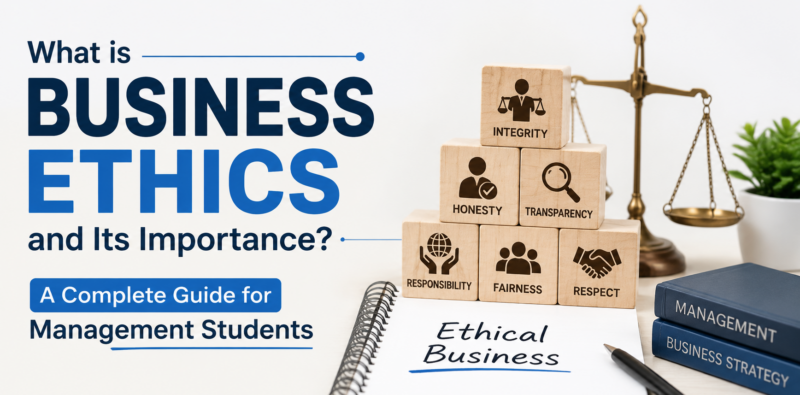
Walk into any boardroom discussion, case study session, or business news debate today, and sooner or later, one phrase tends to surface: business ethics. It gets used often – sometimes loosely, but for anyone pursuing a career in management, understanding what it actually means is not optional. It is foundational.
At its heart, business ethics is about how organisations choose to behave when they have a choice. Every company can technically operate within the law while still making decisions that damage trust, harm communities, or mislead customers. Business ethics is the framework that asks a deeper question: just because something is legal, does that make it right?
For students of BBA and MBA programmes, this is not an abstract philosophical debate. It directly shapes how future managers make decisions, how companies build (or lose) reputations, and how entire industries are regulated and trusted by the public. This guide breaks down the concept of business ethics, why it matters, and what every management student should understand before stepping into the corporate world.
What is Business Ethics?
Business ethics refers to the moral principles, values, and standards that guide how individuals and organisations behave in the business environment. It governs decisions related to how a company treats its employees, customers, investors, competitors, and the wider society in which it operates.
Unlike laws, which are enforced by governments and carry legal penalties, business ethics are largely voluntary. No court can force a company to be honest in its advertising beyond what consumer protection law requires, or to pay its suppliers fairly beyond contractual obligations — but ethical businesses choose to do so anyway, because it reflects their values and protects their long-term interests.
In simple terms, the concept of business ethics can be summed up as: doing the right thing, even when no one is watching, and even when it might cost you something in the short term.
Business ethics touches almost every function within an organisation — from how a marketing team frames an advertisement, to how a finance team reports earnings, to how an HR team handles a workplace complaint. It is not confined to a single department or decision; it is a lens through which every business decision can be evaluated.
The Need for Business Ethics in Today’s Business World
It is fair to ask: if ethics are voluntary, why do businesses bother? The honest answer is that the need for business ethics has never been more pressing — and it comes down to three converging forces shaping the modern economy.
1. Information Travels Faster Than Ever
A single unethical decision — a data breach, a misleading claim, a case of workplace discrimination — can become public knowledge within hours through social media and digital news. Companies no longer have the luxury of quietly managing reputational damage. The need for ethical conduct is now directly tied to a company’s survival in the public eye.
2. Stakeholders Expect More
Customers, employees, and investors increasingly factor ethics into their decisions — which brands they buy from, where they choose to work, and which companies they invest in. A business that ignores ethical expectations risks losing talent, customers, and capital to competitors who do not.
3. Global Operations Mean Global Scrutiny
As Indian companies expand internationally and global companies operate in India, they are held to ethical standards that span multiple regulatory environments, cultures, and expectations. Ethical consistency becomes a competitive necessity, not just a compliance checkbox.
Core Principles That Define the Concept of Business Ethics
While business ethics can apply to almost any situation, most ethical frameworks in business are built around a consistent set of principles. Understanding these is essential for any BBA or MBA student preparing for the corporate world.
| Principle | What It Means in Practice |
| Integrity | Being honest and consistent in actions and decisions, even when it is inconvenient or costly |
| Accountability | Taking responsibility for outcomes — both successes and failures — without shifting blame |
| Fairness | Treating employees, customers, and partners impartially, without favouritism or discrimination |
| Transparency | Communicating honestly — in financial reporting, marketing claims, and stakeholder relations |
| Respect | Valuing the dignity of people — employees, customers, and communities — and their diverse perspectives |
| Responsibility | Considering the broader impact of business decisions on society and the environment, not just profit |
These principles are not isolated ideals — they work together. A company that is transparent about its practices is naturally easier to hold accountable. A company that is fair to its employees often finds it easier to maintain integrity across its operations. Together, they form the operating culture of an ethical organisation.
Importance of Business Ethics: Why It Matters for Every Organisation
The importance of business ethics extends well beyond simply ‘doing good.’ It has tangible, measurable effects on how an organisation performs, grows, and survives in a competitive market. Here is why it matters in practical terms:
1. Building Trust with Stakeholders
Trust is the currency of business. Customers need to trust that a product does what it claims. Employees need to trust that they will be treated fairly. Investors need to trust that financial statements are accurate. Ethical conduct is what builds and sustains this trust over time — and trust, once broken, is notoriously difficult to rebuild.
2. Strengthening Brand Reputation
A company’s reputation is often its most valuable intangible asset. Ethical businesses tend to enjoy stronger brand loyalty, more positive word-of-mouth, and greater resilience during crises — because stakeholders are more willing to give the benefit of the doubt to a company with a track record of doing right.
3. Reducing Legal and Regulatory Risk
While ethics and law are not the same, ethical practices often keep companies well ahead of legal requirements — reducing the risk of regulatory penalties, lawsuits, and compliance failures. Businesses that build ethical decision-making into their culture are less likely to find themselves at the centre of scandals that result in fines or sanctions.
4. Improving Employee Morale and Retention
Employees who feel they work for an organisation with strong values tend to be more engaged, more loyal, and less likely to leave. Ethical workplace practices — fair compensation, safe working conditions, respectful treatment — directly influence how motivated a workforce is.
5. Supporting Long-Term, Sustainable Growth
Short-term gains achieved through unethical shortcuts — misleading advertising, cutting corners on safety, exploiting suppliers — tend to catch up with businesses eventually. Ethical companies, by contrast, build relationships and reputations that compound positively over years, supporting more sustainable growth.
| Build the foundation for a values-driven business career.
IITM Janakpuri’s (Information Campus) BBA programme, affiliated to GGSIPU, introduces students to core management concepts — including business ethics, corporate governance, and organisational behaviour — early in their academic journey. Offered by a NAAC Grade ‘A’ and NBA-accredited institution. |
Objectives of Business Ethics
Understanding the objectives of business ethics helps clarify why organisations invest time and resources into building ethical frameworks, codes of conduct, and compliance training. The key objectives include:
- To establish a framework for fair and responsible decision-making across the organisation
- To protect the rights and interests of all stakeholders — employees, customers, investors, and communities
- To maintain transparency in financial reporting, marketing, and corporate communication
- To prevent practices such as fraud, discrimination, and exploitation within the organisation
- To build and protect the long-term reputation and credibility of the business
- To ensure compliance with legal and regulatory standards while going beyond the minimum where appropriate
- To create a workplace culture that values integrity, accountability, and respect
- To balance the pursuit of profit with the broader responsibility a business holds towards society and the environment
Significance and Relevance of Business Ethics for Management Students
For students currently pursuing or considering a BBA or MBA, the significance of business ethics is not limited to a single subject in the syllabus — it is a thread that runs through almost every area of management education, including:
| Management Area | How Business Ethics Applies |
| Marketing | Ensuring advertising claims are truthful and that consumer data is handled responsibly |
| Finance & Accounting | Accurate financial reporting, avoiding conflicts of interest, preventing fraud |
| Human Resources | Fair hiring practices, equal opportunity, safe and respectful workplaces |
| Operations & Supply Chain | Ethical sourcing, fair treatment of suppliers, environmental responsibility |
| Corporate Strategy | Balancing shareholder returns with stakeholder interests and long-term sustainability |
This is precisely why business ethics is taught as a core subject in most management programmes — not as a theoretical add-on, but as a practical lens that future managers will apply, often without realising it, in their everyday decision-making.
For BBA students, an early grounding in ethical concepts builds habits of thought that carry forward into more advanced MBA-level coursework on corporate governance, leadership, and strategy. For MBA students, particularly those moving into managerial and leadership roles, the ability to navigate ethical dilemmas — situations where there is no single ‘correct’ answer, only trade-offs — becomes a defining skill.
Business Ethics vs. Law: An Important Distinction
One of the most common points of confusion for students is the relationship between business ethics and law. While the two are closely related, they are not the same thing — and the difference matters.
| Aspect | Law | Business Ethics |
| Source | Created and enforced by government and regulatory bodies | Shaped by values, culture, and voluntary codes of conduct |
| Enforcement | Mandatory, with legal penalties for violation | Voluntary, though violations can lead to reputational and commercial consequences |
| Scope | Defines the minimum acceptable standard of conduct | Often goes beyond the legal minimum, towards what is ‘right’ |
| Example | A company must pay the legal minimum wage | An ethical company may choose to pay a fair living wage, even if not legally required |
This distinction is precisely why some of the most significant corporate controversies in business history involved companies that were not necessarily breaking the law — but were widely seen as having acted unethically. Understanding this gap is one of the most valuable lessons a management education can offer.
| Ready to think like a future business leader?
IITM Janakpuri’s (Information Campus) MBA programme, affiliated to GGSIPU, builds on these foundational concepts with advanced coursework in corporate governance, strategic management, and leadership ethics — preparing students to lead organisations responsibly in a complex business environment. |
Frequently Asked Questions (FAQs)
Q1. What is business ethics in simple words?
Business ethics refers to the set of moral principles and values that guide how a company and its employees behave — covering everything from honesty in advertising to fairness towards employees and responsibility towards society. In simple terms, it is about doing business the right way, not just the legal way.
Q2. What is the importance of business ethics for a company?
Business ethics helps a company build trust with customers, employees, and investors; protect and strengthen its brand reputation; reduce legal and regulatory risks; improve employee morale and retention; and support long-term, sustainable growth rather than short-term gains achieved through questionable practices.
Q3. What are the main objectives of business ethics?
The main objectives of business ethics include ensuring fair treatment of stakeholders, maintaining transparency in business operations, preventing fraudulent or discriminatory practices, protecting the company’s reputation, and balancing profit-making with social and environmental responsibility.
Q4. Why is business ethics important for management students?
Business ethics forms a core part of management education because it shapes how future managers approach decision-making across marketing, finance, HR, and operations. For BBA and MBA students, understanding ethical principles early helps build the judgement needed to navigate complex, real-world business dilemmas.
Q5. Is business ethics the same as corporate social responsibility (CSR)?
They are related but not identical. Business ethics refers to the broader set of moral principles guiding all business decisions and conduct. CSR is a more specific concept — it refers to the initiatives a company undertakes to give back to society and the environment, often as an expression of its underlying ethical values.
Q6. What is the relevance of business ethics in today’s business environment?
In an environment shaped by social media, global supply chains, and increasingly conscious consumers, the relevance of business ethics has grown significantly. Companies are now held publicly accountable for their conduct in ways that were less common a few decades ago, making ethical decision-making a practical business necessity rather than just a moral consideration.
Summing it up
Understanding the concept, principles, and significance of business ethics today is, in many ways, preparation for the kind of leader you will choose to be tomorrow. At IITM Janakpuri (Information Campus), the best Management College in Delhi NCR, this thinking is woven into the BBA and MBA curriculum from day one — helping students build not just careers, but the judgement to lead with integrity.