
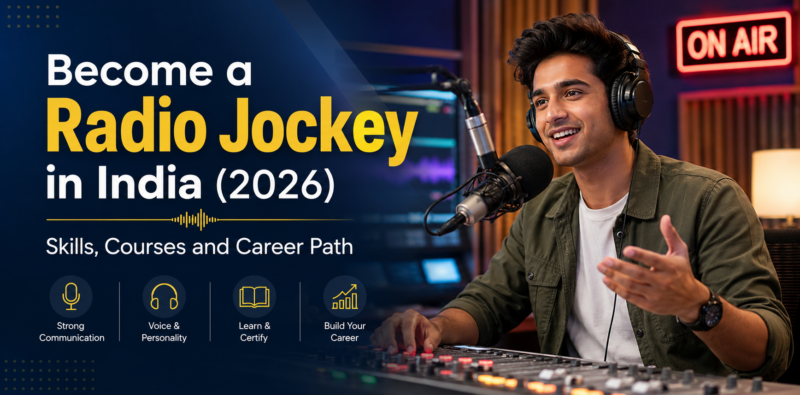
Picture this: It’s 8 o’clock in the morning, thousands of commuters are stuck in traffic, earphones in, radio on — and your voice is the thing getting them through it. You make them laugh. You play the song they needed to hear. You say exactly what they were thinking. That is what a radio jockey does, and if that image excites you, you are reading the right article.
India’s radio industry is shrinking — it is evolving. Among private FM networks spanning 900+ frequencies, digital radio, podcasting, and audio streaming platforms, the demand for skilled, engaging RJ talent is actually growing. This guide walks you through everything you need to know: what the job really involves, what qualifications help, how to land your first break, and what you can realistically earn.
If you are aiming to become a top RJ, consider enrolling at IITM Janakpuri (Information Campus), the best BJMC college in Delhi NCR, which provides comprehensive training, industry exposure, and hands-on experience to help you succeed in the world of radio and mass communication.
What does a Radio Jockey do?
A radio jockey — commonly called an RJ — is a broadcaster who hosts radio programmes. But reducing the job to ‘someone who plays songs’ would be a significant undersell. A good RJ is equal parts entertainer, storyteller, news curator, and spontaneous conversationalist.
On any given day, an RJ’s responsibilities might include:
- Hosting live morning, afternoon, or drive-time shows
- Writing scripts, jingles, and show introductions
- Conducting on-air interviews with celebrities, politicians, or everyday people
- Managing listener interactions — calls, social media, WhatsApp messages — in real time
- Operating broadcast equipment and mixing boards
- Researching trending topics and creating topical content
- Recording advertisements, promotional spots, and station IDs
Voice modulation, mic technique, and the ability to think on your feet are the core technical skills. But what really separates a great RJ from a good one is personality — the warmth, wit, and distinctiveness that makes a listener feel like they are talking to a friend.
Skills You Need to Become a Successful RJ
| Core Skill | Why It Matters |
| Voice Modulation & Clarity | Your voice is your primary instrument — tone, pace, and energy all need to be controlled |
| Spontaneity & Quick Thinking | Live radio has no retakes — you must handle the unexpected with confidence |
| Scriptwriting & Storytelling | Structured content keeps listeners engaged; good writing gives your voice something worthwhile to say |
| Current Affairs Awareness | Topical humour and commentary are staples of morning shows and drive-time slots |
| Language Fluency | Hindi-English code-switching is essential in metros; regional language fluency opens even more doors |
| Interviewing Skills | Getting a celebrity or listener to open up on air requires preparation and genuine curiosity |
| Technical Know-How | Basic proficiency with broadcast software (like Adobe Audition or ProTools) is increasingly expected |
Eligibility: What Qualifications Do You Need?
There is no single prescribed educational route to becoming an RJ in India, but here is the practical reality of what most hiring managers at radio networks look for:
- Minimum qualification: 10+2 from any stream (arts, science, or commerce)
- A bachelor’s degree in Journalism and Mass Communication, or a related field significantly improves your chances
- Formal training in radio broadcasting or audio production — through a diploma, certificate, or degree programme — is a strong differentiator
- A well-developed voice demo reel (often called an ‘aircheck’) is mandatory when applying to any FM station
Most private radio networks hire fresh talent through auditions and training programmes. A relevant degree builds your communication foundation, but your demo reel and on-air personality are ultimately what get you through the door.
RJ Courses in India: What to Study
If you are serious about a radio jockey career in India, formal education in Journalism and Mass Communication gives you the strongest foundation. Here are the most relevant qualifications:
| Course | Duration | What You Learn |
| BA in Journalism & Mass Communication | 3 Years | Broadcasting, scriptwriting, media production, communication theory, PR and advertising |
| Diploma / Certificate in Radio Jockeying | 3–12 Months | Voice training, mic techniques, show production, equipment operation |
| PG Diploma in Broadcast Journalism | 1 Year | Advanced media production, digital broadcasting, journalism ethics |
| MA in Mass Communication | 2 Years | Research, media theory, specialisation in broadcast or digital media |
A BA in Journalism and Mass Communication remains the most well-rounded starting point. It gives you a grounding in broadcast media, communication skills, and media production — all of which are directly relevant to an RJ career — while also keeping multiple career paths open.
How to Become an RJ in India: Step by Step
Step 1 — Build the Foundation
Pursue a degree or diploma in Journalism and Mass Communication, or a related field. This is where you develop the writing, communication, and media production skills that underpin every aspect of the RJ role.
Step 2 — Train Your Voice
Your voice is your professional instrument. Practise daily — reading aloud, recording yourself, experimenting with tone, pace, and energy. Listen back critically. Many aspiring RJs take dedicated voice training or theatre workshops alongside their academic studies.
Step 3 — Create a Demo Reel
A demo reel (or ‘aircheck’) is a 2–3 minute audio clip showcasing your on-air style. It typically includes a show introduction, a music link, a mock interview, and a topical comment. This is the single most important document in your job application. Record it on clean equipment, keep it tight, and make sure every second sounds like you at your best.
Step 4 — Start Small and Start Early
Look for opportunities at college radio stations, community radio, or podcast platforms. RJ internships at regional FM stations are common and genuinely useful. Many of India’s best-known RJs began as production assistants or show researchers before getting behind the microphone.
Step 5 — Apply to Radio Network Auditions
India’s major FM networks — including Radio Mirchi (98.3 FM), Red FM (93.5 FM), BIG FM (92.7 FM), Radio City (91.1 FM), and Fever FM (104.0 FM) — regularly hold talent auditions and trainee programmes. Vividh Bharati, All India Radio’s flagship entertainment channel, also recruits through formal examinations for government positions. Prepare your demo reel, follow each network’s audition process closely, and apply widely.
Step 6 — Build Your Online Presence
In 2026, an RJ without a digital footprint is a missed opportunity. Instagram Reels, YouTube Shorts, and podcast episodes are all excellent ways to demonstrate your on-air personality before you even walk into an audition. Some RJs have been discovered entirely through their online content.
Top FM Radio Networks in India for Aspiring RJs
India has a rich network of private and public radio broadcasters, each with its own flavour and audience:
- Radio Mirchi 98.3 FM — India’s most listened-to private FM network, known for its lively Bollywood-driven content and a roster of high-energy RJs. Home to RJ Naved and Mir Afsar Ali.
- Red FM 93.5 FM — Known for its bold personality and a strong urban youth audience. RJ Malishka, RJ Sayema, RJ Raunac, and RJ Praveen are among its most recognisable voices.
- BIG FM 92.7 FM — One of the country’s widest-reaching networks, with a programming mix that spans retro Bollywood, regional hits, and long-form talk shows.
- Radio City 91.1 FM — A strong presence across multiple cities, with a programming approach that blends Bollywood, regional music, and localised talk content.
- Fever FM 104.0 FM — Particularly strong in Delhi, Mumbai, Bengaluru, and Kolkata, with a focus on current Bollywood and contemporary pop.
- Vividh Bharati (All India Radio) — The public broadcaster’s entertainment arm and one of the oldest radio institutions in India. A career here carries different prestige and stability compared to private FM.
Famous Indian RJs Who Built Brilliant Careers
If you need proof that a radio career can be extraordinary, look no further than these names:
- RJ Naved (Radio Mirchi, Delhi) — Famous for his prank call segment ‘Mirchi Murga’, which turned hidden-camera-style audio comedy into a radio institution. His ability to improvise in the moment is a masterclass in live broadcasting.
- RJ Malishka (Red FM, Mumbai) — One of the most recognisable voices in Indian radio, known for her high-energy morning shows and sharp social commentary. She has been a consistent fixture on Mumbai’s airwaves for over two decades.
- RJ Balaji (BIG FM, Chennai) — Proof that radio fame can translate into mainstream stardom. Balaji leveraged his RJ popularity into a successful film career in Tamil cinema while remaining one of the best-known RJs in South India.
- Mir Afsar Ali (Radio Mirchi, Kolkata) — Beloved across Bengal and beyond, Mir’s morning show ‘Mirchi 98.3 Kolkata’ has been a listener favourite for years. He is also a popular television host and actor.
- RJ Sayema (Red FM, Delhi) — Known for giving listeners a safe space for genuine conversations on-air, RJ Sayema has built one of the most trusted voices on Delhi’s FM dial, with a loyal following that extends well beyond radio.
- RJ Raunac and RJ Praveen (Red FM) — Popular voices on Red FM’s national network, both known for engaging show formats and strong listener connection.
Radio Jockey Salary in India: What Can You Earn?
Radio jockey salaries vary significantly based on network, city, time slot, and years of experience. Here is a realistic picture:
| Career Stage | Experience | Approx. Salary (Per Annum) |
| Trainee / Junior RJ | 0 – 1 Year | ₹1.8 – 3 LPA |
| RJ (Mid-Level) | 2 – 5 Years | ₹4 – 10 LPA |
| Senior / Prime-Time RJ | 5 – 10 Years | ₹10 – 18 LPA |
| Celebrity / Network RJ | 10+ Years | ₹20 LPA and above |
Figures are approximate and based on AmbitionBox and industry salary data (2025–26). Metro cities and prime-time slots command higher pay.
Beyond base salary, established RJs earn through brand endorsements, live event hosting, corporate gigs, and social media partnerships — which can significantly exceed their on-air income.
| Ready to find your voice?
IITM Janakpuri’s BA in Journalism and Mass Communication (BA JMC) is affiliated to GGSIPU and covers broadcasting, media production, scriptwriting, PR, advertising, and digital journalism. It is offered by a NAAC Grade ‘A’ and NBA-accredited institution in Janakpuri, West Delhi — giving you both the academic foundation and the practical exposure that a media career demands. |
Frequently Asked Questions
Q1. What is the minimum qualification to become a radio jockey in India?
While there is no fixed qualification requirement, most radio stations prefer graduates with strong communication and presentation skills. A degree in Journalism and Mass Communication, Broadcasting, or Media Studies can provide valuable industry-relevant training and improve career prospects.
Q2. Is a specific RJ course necessary to get into radio?
No, a specific RJ (Radio Jockey) course is not mandatory to become a Radio Jockey. Employers primarily look for strong communication skills, voice quality, creativity, language proficiency, and the ability to engage audiences.
However, formal education in Journalism and Mass Communication, Radio Production, Broadcasting, or Media Studies can provide valuable training in voice modulation, scriptwriting, content creation, interviewing, and broadcasting techniques. Internships, college radio experience, podcasts, and practical broadcasting exposure are often just as important as academic qualifications in building a successful RJ career.
Q3. How do I get an internship at a radio station in India?
Most major FM networks accept internship applications through their official websites or campus recruitment programmes. Colleges with active placement cells and media industry connections can help facilitate these. Reaching out directly to a station’s programming team with a short, polished demo reel is another approach that has worked well for many aspiring RJs.
Q4. Can I become an RJ after 12th, without a degree?
Some radio stations hire purely based on auditions, demo reels, and raw talent. However, pursuing a graduate degree in Journalism and Mass Communication, or broadcasting can significantly enhance your communication skills, expand your professional network, and open up long-term career opportunities in media. Most successful RJs recommend combining formal education with voice and presentation training to stand out in the industry.
Q5. How long does it take to become a professional radio jockey?
Realistically, expect two to four years from starting a relevant degree to landing your first paid RJ position. The path includes a three-year bachelor’s programme, followed by internships, demo reel development, and auditions. Some exceptionally talented individuals break in earlier; for most people, consistent preparation over two to four years is a realistic timeline.
Final Thought
Radio has survived television, the internet, and streaming — and it is not going anywhere. The medium has simply evolved, and so has the RJ’s role. Today’s radio jockey is also a content creator, a social media personality, and often a public figure who extends their reach well beyond the airwaves.
If you have the voice, the curiosity, and the personality for it, this is a career worth chasing seriously. Start with the right education at IITM Janakpuri (Information Campus), where admissions are now open for the BJMC program. Train your craft every day, build a demo reel you are proud of — and then go find your frequency.